
Bubna’s IAS Launches Free GPSC Mains History Course on YouTube – Covering Complete Gujarat-Specific Syllabus!
Are you preparing for GPSC Mains 2025 and looking for high-quality, Gujarat-focused History content—all for free? Bubna’s IAS, Gujarat’s trusted name in civil services preparation, is proud to launch a completely free online course on GPSC Mains History via YouTube. This course is a golden opportunity for serious aspirants to master the Gujarat-specific history syllabus with conceptual clarity and smart answer-writing techniques.
In this blog, we’ll walk you through what’s covered, how it’s designed, and why you simply cannot afford to miss this offering.
YouTube Playlist link: click here
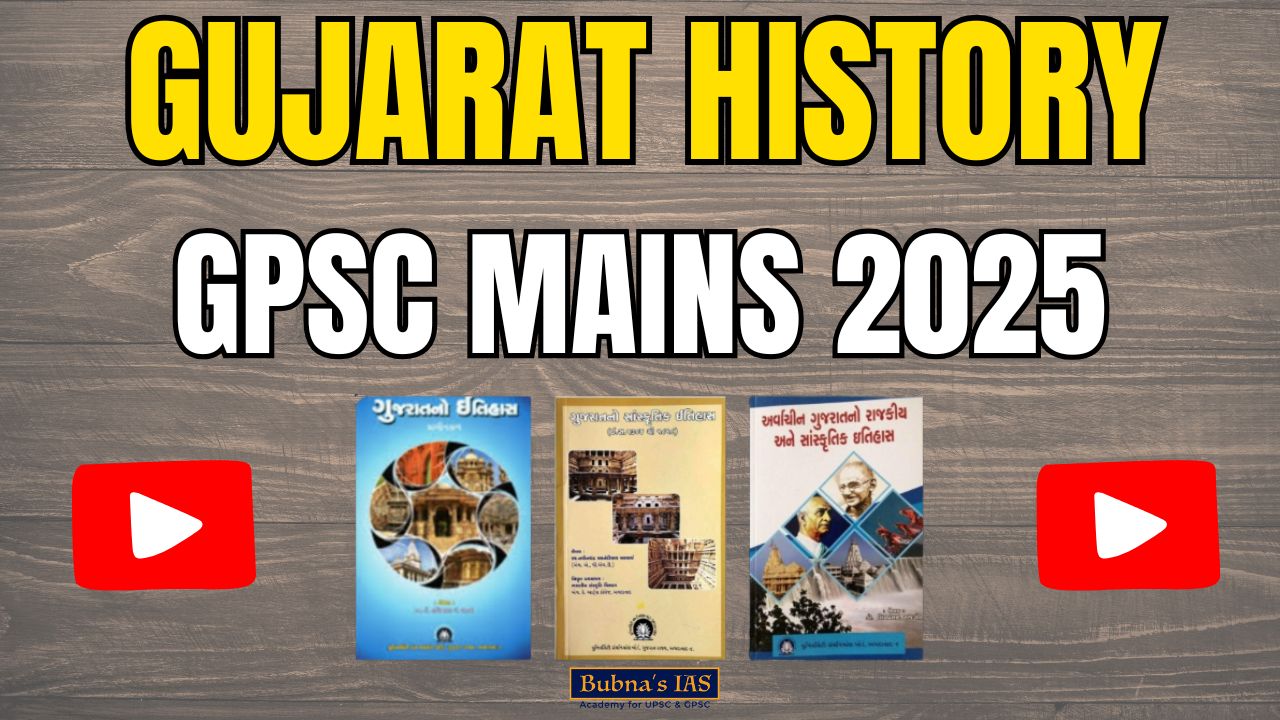
Why GPSC Aspirants Must Focus on Gujarat-Specific History Topics
The Gujarat Public Service Commission (GPSC) gives considerable weight to Gujarat’s history, personalities, and movements in both Prelims and Mains. In GPSC Mains Paper 1 (General Studies), there are direct questions from Gujarat’s ancient, medieval, and modern periods, along with special emphasis on social reforms, freedom struggle, and the Mahagujarat Movement.
Cracking these topics gives you a strategic edge over other aspirants. Yet, authentic and concise content on Gujarat history is hard to find. That’s exactly where Bubna’s IAS steps in with this YouTube series.
What the Course Covers – Full Breakdown of Gujarat-Specific Topics
Our expert faculty dives deep into the official syllabus and teaches with examples, visuals, maps, and model answers, giving you not just information—but insight.
Here’s a snapshot of the Gujarat-specific topics we cover:
Ancient to Modern Gujarat: Political, Religious, Social & Economic Evolution
We cover the entire spectrum of Gujarat’s transformation:
- Ancient Gujarat – Mauryan rule, Junagadh rock edicts, Gupta influence, Maitrakas of Vallabhi.
- Medieval Gujarat – Chavda, Solanki, Vaghela dynasties, the Delhi Sultanate’s control, Gujarat Sultanate, and Mughals in Gujarat.
- Ports & Trade – Importance of Bharuch, Cambay (Khambhat), and Surat as trading ports.
- Religious Trends – Spread of Jainism, Shaivism, Vaishnavism, and later the Swaminarayan sect.
- Caste & Social Hierarchy – Impact on land ownership, power structure, and reforms over time.
- British Period in Gujarat – Political integration, land revenue systems, princely states (Baroda, Junagadh), and resistance movements.
Social Reform Movements in Gujarat (19th Century)
Our lectures spotlight how Gujarat responded to the reform waves sweeping India:
- Reformers Covered:
- Rao Bahadur M.C. Ranji – Social justice efforts
- Narmadashankar Dave (Narmad) – Gujarat’s first modern thinker
- Gopalrao Deshmukh – Impact on Western India including Gujarat
- Swami Dayanand Saraswati – Arya Samaj’s spread and reforms
We analyze their ideas, writings, and the reforms they triggered on caste, widow remarriage, and women’s education.
Modern History: Gujarat from Mid-18th Century to Independence
Key episodes that shaped modern Gujarat are covered with timeline-based lectures, such as:
- British Conquest of Gujarat
- Revolt of 1857 in Gujarat – Role of local leaders like Tatya Tope and resistance pockets.
- Gandhian Era in Gujarat:
- Kheda Satyagraha (1918)
- Bardoli Satyagraha (1928)
- Dandi March (1930)
- Quit India Movement in Gujarat
- Personalities That Shaped the Freedom Struggle:
- Mahatma Gandhi
- Sardar Vallabhbhai Patel
- Indulal Yagnik
- Ravishankar Maharaj
Each movement is taught in terms of cause, course, consequences, and its place in the national context.
Mahagujarat Aandolan (Post-Independence Movement)
This section is 100% Gujarat-centric and high in importance for Mains:
- Origin and background: Linguistic reorganization of states
- Role of Indulal Yagnik, Jivraj Mehta, Umashankar Joshi
- Political pressure, public protests, and eventual formation of Gujarat state in 1960
- Impact on state politics and identity
We also teach how to write critical evaluations and balanced views on Mahagujarat Aandolan in UPSC/GPSC style answers.
Other Topics With Gujarat Linkages
These India-centric syllabus areas are also explained with Gujarat-specific angles:
Indus Valley Civilisation, Vedic Age, Jainism & Buddhism
- Sites like Dholavira (UNESCO World Heritage Site) and Lothal (dockyard, trade hub)
- Jain and Buddhist influences at Girnar, Junagadh, and Vallabhi
Bhakti Movement
- Gujarati saints like Narsinh Mehta, Dayaram, Akha Bhagat
- Influence of Vaishnavism and Swaminarayan sect
Freedom Struggle: Gujarat’s Contribution
- Gandhiji’s Sabarmati Ashram as a movement hub
- Salt Satyagraha starting from Dandi
- Sardar Patel’s role in Bardoli and political integration
Why Choose Bubna’s IAS YouTube Course?
- Complete coverage of GPSC Mains History syllabus – with Gujarat focus
- Lecture notes, MCQs, and model answer writing practice
- Delivered by top educators who understand GPSC demand
- 100% FREE – Learn from anywhere, anytime
- Regular uploads with structured playlists
Call to Action – Subscribe & Share!
Whether you’re just starting your GPSC journey or revising for mains, this course will supercharge your preparation. Don’t forget to:
Subscribe to our YouTube Channel – Bubna’s IAS Academy
Hit the 🔔 bell icon so you don’t miss any video
Share with your fellow aspirants and WhatsApp groups
IMPORTANT LINKS
Website: www.bubnasias.com
Instagram: https://www.instagram.com/bubnasias/
Telegram: https://t.me/bubnasias
YouTube: www.youtube.com/channel/UCntPgT1oZdSXJIWn8kVxuWQ
Google Reviews: https://g.page/r/CXlJ2QWU-AJAEAo/review
WhatsApp chat: https://Wa.me/919909556660
Final Words
Gujarat’s history isn’t just a subject—it’s your identity in the exam. Knowing it well can fetch you marks and help you write authentic, original, and localized answers. Bubna’s IAS is committed to making GPSC success accessible to every serious student in Gujarat.
Join the revolution in learning. Start your History Mains preparation with us—today.