
How to Write an Essay for UPSC & GPSC Mains: Complete Strategy for Beginners
The Essay paper is one of the most decisive papers in both UPSC Civil Services Examination and GPSC Mains. Unlike General Studies papers that primarily evaluate factual knowledge, the essay paper assesses your ability to think critically, organize ideas logically, and express them coherently.
Many aspirants spend months mastering Polity, Economy, History, Geography, and Current Affairs but dedicate very little time to essay writing. As a result, even well-prepared candidates often score below their potential.
The good news is that essay writing is a skill—not a talent. It can be developed through a systematic approach, regular practice, and constructive feedback.
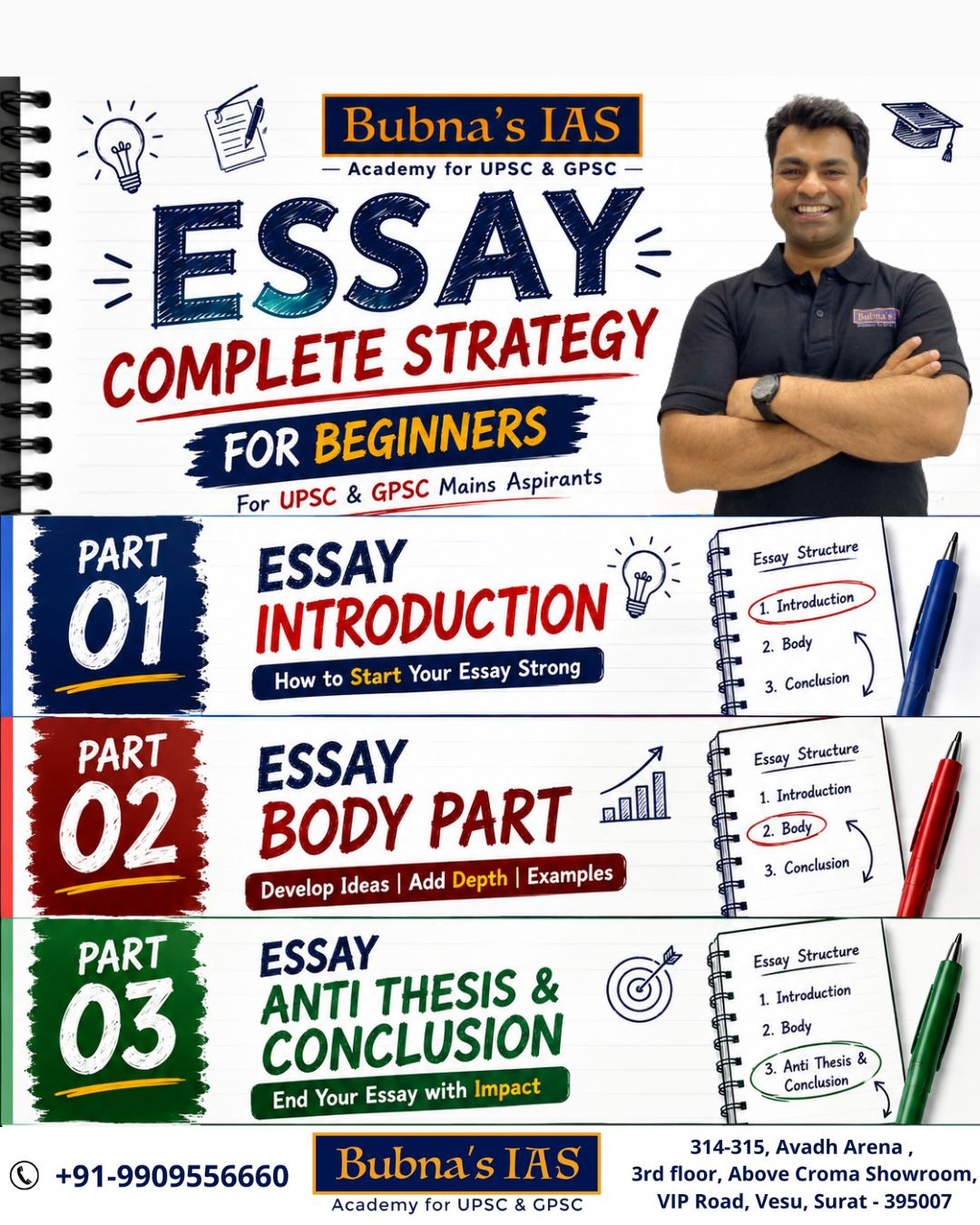
In this comprehensive guide, we explain the complete essay writing strategy for beginners through a simple three-part framework:
- Writing a powerful introduction
- Developing a multidimensional body
- Crafting an impactful anti-thesis and conclusion
This is the same structured approach explained in Bubna’s IAS Essay Strategy Lecture Series.
Why is the Essay Paper Important?
Many aspirants underestimate the importance of the Essay paper because it consists of only one paper. However, essay marks often create the difference between selection and rejection.
A high-quality essay demonstrates:
- Analytical thinking
- Balanced opinion
- Constitutional values
- Ethical reasoning
- Creativity
- Logical flow
- Communication skills
Unlike objective examinations, the essay paper allows candidates to showcase their personality and maturity of thought.
Common Mistakes Beginners Make
Most first-time aspirants make predictable mistakes while writing essays.
Some of the most common errors include:
- Jumping directly into writing without brainstorming
- Weak introductions
- Repetition of the same ideas
- Excessive factual content with little analysis
- Lack of multidimensional thinking
- One-sided arguments
- Abrupt conclusions
- Poor paragraph transitions
- No examples or case studies
- Ignoring constitutional and ethical dimensions
Fortunately, these mistakes can be avoided through a structured writing methodology.
The Three-Step Essay Writing Framework
Instead of treating essay writing as a single activity, divide it into three distinct stages.
Part 1: Writing a Powerful Introduction
The introduction is the first impression your evaluator receives. Within the first few paragraphs, the examiner forms an opinion about the quality of your essay.
A strong introduction should:
- Capture attention
- Introduce the theme
- Clarify the scope
- Maintain relevance to the topic
- Create curiosity for the reader
Different Ways to Begin an Essay
You can start your essay using various approaches depending on the topic.
Some effective methods include:
1. Quote-Based Introduction
Use a relevant quotation from philosophers, leaders, or thinkers.
Example:
“Education is the most powerful weapon which you can use to change the world.” — Nelson Mandela
2. Historical Introduction
Begin with a historical event that connects naturally to the essay topic.
3. Constitutional Perspective
Use relevant constitutional values, Fundamental Rights, Directive Principles, or the Preamble.
4. Current Affairs Introduction
Connect the topic with recent national or global developments.
5. Story or Anecdote
A short real-life incident can create an engaging opening.
Watch the Complete Lecture
📘 Lecture 01: Essay Introduction
In this lecture, you’ll learn practical techniques to start every essay confidently and effectively.
Part 2: Building a High-Scoring Essay Body
The body forms nearly 80% of your essay and determines the overall quality of your answer.
The biggest mistake aspirants make is discussing only one dimension of the topic.
Instead, every UPSC and GPSC essay should include multiple perspectives wherever relevant.
Think in Multiple Dimensions
A high-scoring essay often covers:
Historical Perspective
How has the issue evolved?
Political Perspective
Government policies, democracy, institutions.
Constitutional Perspective
Fundamental Rights, DPSPs, Constitutional values.
Economic Perspective
Growth, employment, inequality, fiscal implications.
Social Perspective
Education, gender, caste, health, inclusion.
Ethical Perspective
Justice, integrity, accountability, compassion.
Environmental Perspective
Sustainability and climate concerns.
Technological Perspective
Digital transformation, AI, innovation.
International Perspective
Global comparisons, SDGs, international cooperation.
Governance Perspective
Public administration, reforms, transparency, citizen participation.
Use Examples Frequently
Good essays are supported by evidence.
Include:
- Government schemes
- Supreme Court judgments
- Constitutional Articles
- NITI Aayog reports
- Economic Survey
- Census data
- Committee recommendations
- Real-life case studies
- Inspirational personalities
Examples improve credibility and make arguments more persuasive.
Maintain Logical Flow
Every paragraph should naturally connect with the next.
Avoid isolated points.
Instead, build a narrative where each section strengthens the central argument.
Watch the Complete Lecture
📘 Lecture 02: Essay Body Part
This lecture explains how to expand ideas, add analytical depth, and maintain logical continuity throughout the essay.
Part 3: Anti-Thesis and Conclusion
One of the biggest differences between average and outstanding essays is balance.
UPSC values balanced thinking.
Instead of presenting only one viewpoint, acknowledge opposing perspectives wherever appropriate.
This demonstrates intellectual maturity.
For example:
If discussing technological advancement, also mention concerns regarding privacy, employment displacement, and digital inequality.
If discussing economic growth, also analyse environmental sustainability.
This balanced discussion is known as presenting the anti-thesis.
Writing an Excellent Conclusion
The conclusion should never merely summarize the essay.
Instead, it should:
- Inspire optimism
- Reinforce the central idea
- Offer a practical way forward
- Reflect constitutional values
- Leave a lasting impression
Avoid introducing completely new arguments in the conclusion.
Instead, synthesize the discussion into a positive and forward-looking ending.
Watch the Complete Lecture
📘 Lecture 03: Anti-Thesis & Conclusion
This lecture explains how to conclude essays effectively while maintaining balance and depth.
Practice Strategy for Beginners
Essay writing improves only through deliberate practice.
An effective preparation plan includes:
- Reading editorials daily
- Maintaining quote and example notebooks
- Practising one essay every week
- Analysing topper copies
- Getting expert feedback
- Revising introductions and conclusions regularly
- Developing multidimensional thinking
Consistency is more important than writing numerous essays without feedback.
Why This Strategy Works for UPSC & GPSC
This structured three-step framework helps aspirants:
- Develop analytical thinking
- Improve presentation
- Organize ideas effectively
- Reduce writing anxiety
- Build confidence
- Score consistently higher
Rather than memorizing essays, candidates learn how to think, structure, and communicate effectively under examination conditions.
Why is this Important for UPSC?
The UPSC Essay paper evaluates not only knowledge but also personality traits such as clarity of thought, balance, originality, and ethical reasoning.
A structured approach significantly improves scoring potential.
Why is this Important for GPSC?
GPSC Mains also emphasizes analytical thinking and structured expression. Candidates who learn to organize ideas logically perform better across descriptive papers, not just the essay paper.
Possible UPSC & GPSC Prelims Linkages
While essay writing itself is not tested in Prelims, effective essays rely on factual knowledge from:
- Indian Constitution
- Governance
- Economy
- Environment
- Science & Technology
- Ethics
- Current Affairs
Possible UPSC & GPSC Mains Questions
- Why is essay writing considered a reflection of administrative aptitude?
- Discuss the importance of multidimensional thinking in essay writing.
- How can constitutional values enrich essay writing in Civil Services examinations?
- Explain the role of balanced arguments in high-scoring essays.
- Discuss how current affairs can be integrated into essay writing effectively.
Interview Relevance
The ability to think critically and articulate balanced opinions—developed through essay writing—is equally valuable during the Personality Test (Interview). Candidates who regularly practise essays often communicate with greater clarity and confidence.
Frequently Asked Questions (FAQ)
1. How should beginners start preparing for the UPSC Essay paper?
Begin by understanding essay structure, reading quality editorials, practising one essay per week, and seeking expert feedback.
2. How many essays should I practise before the exam?
Quality matters more than quantity. Writing and reviewing 30–40 well-analysed essays is generally more beneficial than writing a large number without feedback.
3. Is current affairs important for essay writing?
Yes. Current affairs help make your essays relevant, contemporary, and supported with recent examples.
4. Can I score above 140 in the UPSC Essay paper?
Yes. Candidates who combine structured thinking, multidimensional analysis, and consistent practice have the potential to achieve high scores.
5. Is the same strategy useful for GPSC Mains?
Absolutely. The principles of clear structure, balanced arguments, strong examples, and effective conclusions apply to both UPSC and GPSC essay papers.
Suggested Internal Linking
- How to Prepare for UPSC Mains
- Best UPSC Test Series for Answer Writing
- Complete GPSC Mains Preparation Strategy
- Current Affairs for UPSC & GPSC
- Geography Optional Strategy by Bubna’s IAS
Suggested External References
- UPSC Official Notifications
- GPSC Official Website
- PIB
- PRS Legislative Research
- NITI Aayog
- Economic Survey of India
- India Year Book
Conclusion
Essay writing is not about using difficult vocabulary or presenting lengthy arguments. It is about expressing clear, balanced, and well-structured ideas supported by evidence and constitutional values. With the right framework, regular practice, and thoughtful feedback, any aspirant can significantly improve their essay-writing skills.
The three-step strategy—crafting a compelling introduction, developing a multidimensional body, and ending with a balanced anti-thesis and impactful conclusion—provides a practical roadmap for success in both UPSC and GPSC Mains. Instead of fearing the essay paper, treat it as an opportunity to showcase your personality, analytical ability, and administrative potential.
If you are looking for structured essay preparation with expert guidance, regular evaluation, and personalized feedback, Bubna’s IAS offers comprehensive mentorship programs designed to help aspirants excel in the Essay paper as well as the overall Civil Services Mains examination.
| Platform | Link |
|---|---|
| 🌐 Website | https://bubnasias.com/ |
| https://www.instagram.com/bubnasias/ | |
| 📢 Telegram | https://t.me/bubnasias |
| ▶️ YouTube | https://www.youtube.com/channel/UCntPgT1oZdSXJIWn8kVxuWQ |
| ⭐ Google Reviews | https://g.page/r/CXlJ2QWU-AJAEAo/review |
| 💬 WhatsApp Chat | https://wa.me/919909556660 |